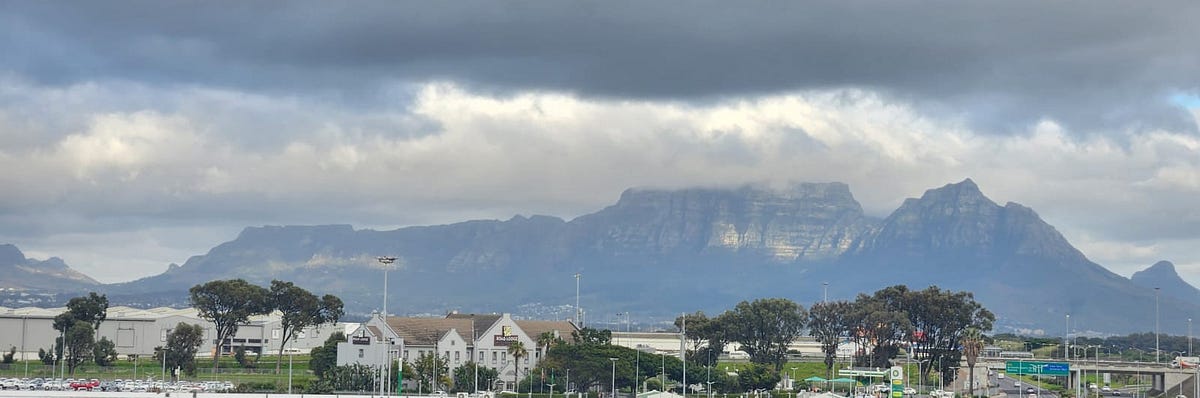
Cape Town was the 2nd place we visited after Knysna and it was markedly different. The black population was in much larger numbers, the whites probably largely tourists.
A small town with many places of interest. — one can take their time seeing them or one can hire a car for a day and cover most of them in one day (like we did). the best we could do in the 2.5 days we had in the town. However we got just a birds eye view of each
A bit of advice: Book your tours of interest at least a month or so in advance as they are quickly sold out.
Unfortunately, the cable car to the Table Mountain was under maintenance and we were not in the mood to trek 4- 5 hrs up to it — so gave it a miss. Similarly, the lines to enter the cape point and light house (where the Atlantic and Indian Ocean meet) where so long that just to enter the compound would have taken us two hours- so that too was a miss for.
So we did not visit the two most famous places of Cape Town- but as they say — you must leave somethings so that you can visit again 🙂
Boulders Beach falls enroute on the drive to Cape Point. It is so called after the rounded boulders which shelter a beautiful swimming beach giving a unique opportunity to swim with Jackass (African) penguins.


while walking towards the beach we came across a family of penguins- parents and a young one. Seeing us approach the father penguin came waddling towards us and went dancing beyond taking us away his young one.
Chapman’s Peak is a mountain on the western side of the Cape Peninsula, between Hout Bay and Noordhoek in Cape Town, South Africa. The western flank of the mountain falls sharply for hundreds of meters into the Atlantic Ocean, and a road, known as Chapman’s Peak Drive, hugs the near-vertical face of the mountain.


Chapman’s Peak Drive is part of the route of two of South Africa’s biggest mass-participation races, the Cape Argus Cycle Race and the Two Oceans Marathon.
Hout Bay offers Duiker Island Seal Colony Cruise where you can swim, snorkel or simple enjoy seeing the fur seals — there is an option to take glass bottomed cruise boats.

Twelve Apostles are a series of 12 mountains adjacent to each other overlooking the ocean on way to the Camps Bay area-


Camps Bay is a popular beach for joggers, dog walkers, picnic-ers and strollers. the beach front has many quaint and vibrant cafes and bars offering music, food and drink.
The African Market in Green Square in the center of the town. a quadrangle where individuals set up their stores selling african


crafts and artifacts. Often people from different countries of Africa (Zimbabwe, Mozambique, Senegal etc.) take a monthly visa and come here to set up their stores to sell their wares. Bargaining is suggested.
Interestingly, similar artefacts are sold all over Cape town- and the price varies with the place of sale as well as the willingness of the salesperson to lower their prices.
Kirstenbosch National Botanical Garden nestled at the foot of Table Mountain was founded in 1913 by Jan van Riebeeck — the then ambassador to preserve the flora and fauna native to South Africa. It places a strong emphasis on the cultivation of indigenous plants. it has propagated a yellow Birds of Paradise commemorating Nelson Mandela. (ordinarily the flower is of an orange colour)


The Camphor Avenue right at the start of the gardens actually smells of camphor if you pass by it

The gardens are huge with areas devoted to succulents, oak trees (some more than 100 years old), annuals, perennials, glass house plants, amazing Bonsais, it has many small and large lakes which support fishes, ducks, amphibians. Many birds, butterflies, small animals are regular visitors.
The Bo-Kaap (also called the Malay Quarter), was a racially segregated area, and today the majority of its residents are Muslims.

Bo-Kaap is known for its brightly coloured homes and cobblestoned streets. The area contains the largest concentration of pre-1850 architecture in South Africa and is the oldest surviving residential neighborhood in Cape Town.
Robben Island used to be synonymous with isolation and was variously used as a prison, leper colony and an asylum. Through the course of its history, this small island has been a post office, military outpost and port for ships visiting Table Bay. However, the island is most renowned as the site of the maximum-security prison for political prisoners opened in 1961 to detain the leaders of the anti-apartheid revolution. The most notable of the island’s inmates is Nobel Laureate and former President of South Africa, Nelson Mandela, who spent 18 years of his 27-year sentence at Robben Island.
A popular tour — fully booked months in advance- another place we were unable to visit.
The V&A Waterfront (Victoria and Alfred Waterfront) is named after Prince Alfred and Queen Vicotria. It is a working harbour — Sitting on top of the nearby giant ferris wheel we could see cargo ships going in and out.
It has Aquariums, the Diamond Museum, many shops and Restaurants. Generally a fun place filled with local music — we were advised by the hotel people not to be there late night-so we did not go in the evening.
The Slave Museum, the District 6 Museum, the Flower market at Trafalgar square are other things that can be seen.
We visited South Africa, Knysna, Johannesburg and the Kruger National Park — a separate write up for each