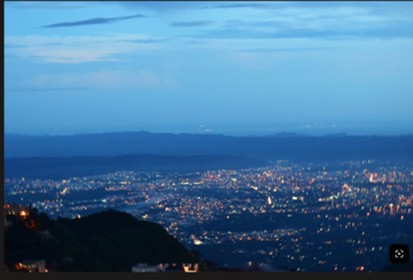
Think Dehradun and you visualize a small-time town with huge, shady trees around few bungalows along the road. A slow pace of life, cool weather, a view of the mountains in the distance and a great place to relax. A place where many army personnel retired and settled.
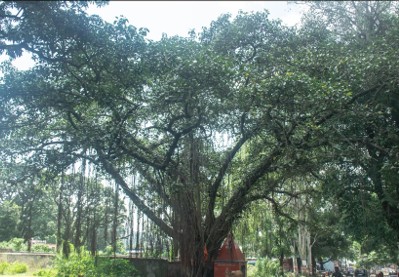
You could not be more wrong.
Today Dehradun is a crowded busy hustling town where people, cows, dogs, vehicular traffic and “Jaloos” all vie for space on the original narrow streets and roads. Add to this the whizzing two wheelers – with no care for rules nor pedestrian- which are available for rent all over the city.
The original Bazars remain- Paltan bazaar, Jhanda bazaar, Tibetan market, Moti bazaar, Rajput Road but new Malls and latest brand showrooms have sprung up all over the city- often with multiple outlets. Despite being in the seismic zone multi storied buildings are springing up all over the city, to the chagrin of local residents.
Dehradun itself derives its name from the historical fact that Ram Rai, the eldest son of the Seventh Sikh Guru, set up his “Dera” (camp) in “dun” (valley or tract below the mountain) in 1676. This ‘Dera Dun’ later on became Dehradun. Till date, 5 days after Holi, the Jhanda Mela commemorates Ram Rai ‘s arrival in the Doon Valley by raising a massive banner (jhanda) during the Mela.
Dehradun has an ancient connection with Gorkhas as well as with Afghans. (source wiki)
Gorkhas ruled it- along with most of the northern parts of Himachal in the early 19th Century till in the Battle of Khalanga, the British defeated and pushed them back. Till date there are localities predominated by Gorkha and Nepalese residents.
The British in their attempt to bring Afghanistan under their dominance fought the then Afghan ruler Emir Dost Mohammad Khan, defeated and exiled him to Dehradun. They installed the more amicable and subversive Shuja Shah Durrani at Afghanistan achieving their target. Dost Mohammad stayed at Mussourie for nearly 6 years. He was fond of his pulao’s – so he brought the Afghan basmati rice to the valley. 40 years later , his grandson Mohammad Yakoob, was also exiled to India and he was the 1st Afghan who chose to settle in Dehradun.Yakoob encouraged cultivation of the Basmati rice plants. The soil, weather of Dehradun favoured the plants so much that they grown variety far exceeded the original in taste and quality-
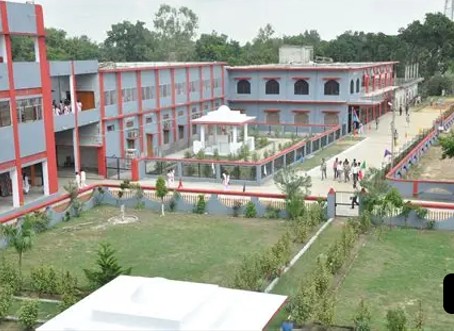
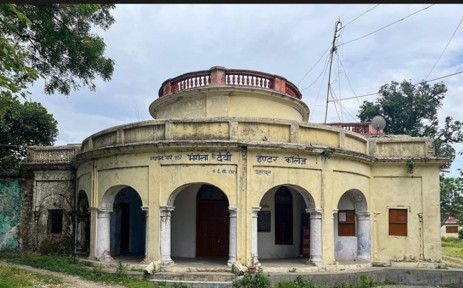
The present Mangla Devi Inter College (above) was once the Kabul Palace where Yakoob stayed with his family and retinue of servants
Another of Yakoob property the Kabul House where descendants of the original retainers had been living since the past 100 years was demolished on the pretext of it belonging to an enemy nation and rendering 16 families homeless.
Due to a dear friend, who retired from the Indian Railway Services we had the good fortune to visit a residential school Oak Grove School in Mussoorie.
the 1st Railway Hill school, modeled after schools in England, built by the British in 1888 for the children of their railway employees who were unable to send their offspring to England for education. It started with 28 students and today has 400 + residential students.
Set amidst Oak trees more than 100 years old (hence the name), the school is spread over nearly 320 acres and has distinct buildings for the sr. secondary schools for girls and boys. The junior schools hold heterogenous classes.
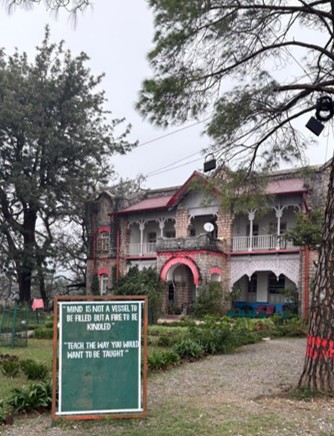
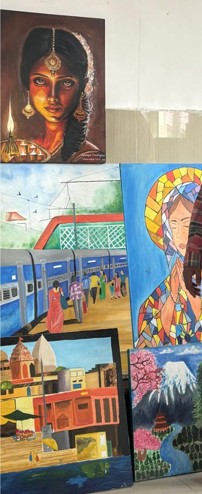
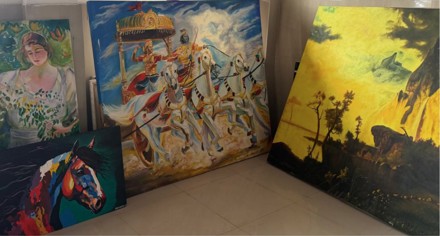
Besides book learning (classrooms are equipped with smart TVs) the emphasis on sports, arts, conservation (they have their own water recycling plants) is rigorously followed. More than 200 artworks by students are displayed on the many walls of the school.
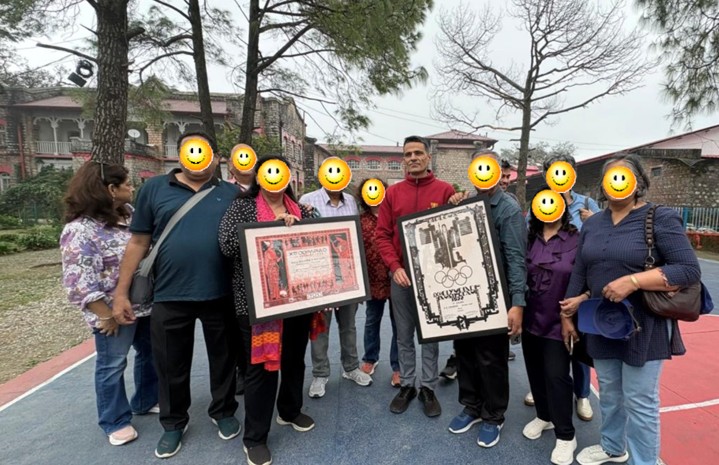
The school also has the prestige of fostering 4 Olympic Gold Medalists who played for the Indian Hockey team in 1928 ,1932 and 1936. Our own Dhyan Chand was a team mates as well.
Richard James Allen (born in Nagpur)
Broome Eric Pinniger (born Sahranpur)
Leslie Charles Hammond (born in Madras) and
Richard John Carr (born in Biihar).
Recently the grandson of Eric Pinniger presented the Olympic trophies/ certificates (below) to the school
Even current students win medals in interschool sports and gymnastics competions. Easy for them to train for speed, stamina and endurance. The school premises—with its multi levels, steep inclines and long stretches of track provide enough training ground to them!
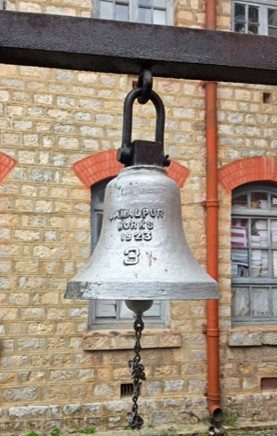
Another relic from the past the school bell – earlier used to call all for the church prayers. Made from steel in the Jamalpur factory in 1923.
Jamalpur workshop in Bihar was the first Railway workshop in the country established by East Indian Railways. As they started the school as well it was natural that the bell came from the workshop.
Incidentally, they had also planned to bring the railway track right unto the school compound but the plan got derailed.
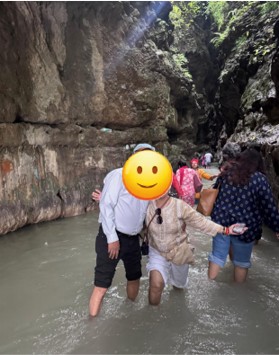
Robber’s Cave (locally known as Guchhupani), is a river cave formation wherein a subterranean stream runs between a narrow gorge of limestone caves for about 600 meters or so.
Robber’s Cave (locally known as Guchhupani), is a river cave formation wherein a subterranean stream runs between a narrow gorge of limestone caves for about 600 metres or so.
Believed to be the hideout of the Sultana Daaku and his band of dacoits it is today called Robber’s Cave.
The image shows only the entrance of the caves – it runs backwards via a narrow gorge for quite a distance.
Atthe moment the water level was knee high but in monsoons the entire gorge is flooded. The mute, smooth and slightly mossy sides of the cavern bear testimony.
A popular spot for pre wedding shoots.
The Great Peace Stupa at the Mindrolling Monastery at Dehradun
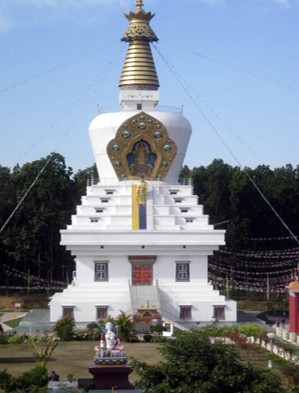
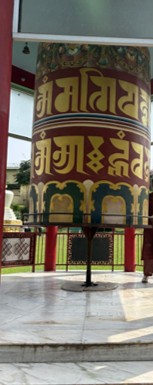
The stupa signifies Buddha’s descent from Devalok. On each side of the stupa are eight stupas which commemorate Buddha’s life.
Pristine, peaceful and beautiful to just be there and look around. Could not enter the stupa central halls as it closes from 12:00 noon till 2:30 pm but apparently there are some relics of importance stored inside.
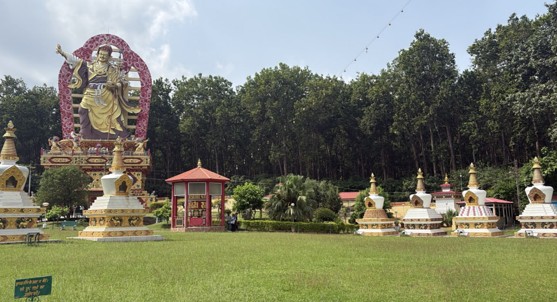
Some Gyaan:
The 8 kind of stupas are as below ( as depicted in a billboard on the grounds):
Stupa of Heaped Lotuses: At Lumbini when Buddha was young, he took steps in all the four directions and lotuses sprang up where he walked. Lotuses symbolized love, compassion, joy and equanimity.
Stupa of Enlightenment: when Buddha at 35 yrs attained it in Bodhgaya
Stupa of Many Doors when he turned the 1st wheel of Dharma in Sarnath
Stupa of Miracles when, in Shravasti Buddha overcame heretics.
Stupa of Buddhas descent from Devalok: At 42 years Buddha visited the heavenly realm of 33 types of devas and then descended in Sankasya to teach Dharma
Stupa of Reconciliation: where he reconciled the diverse factions of Buddhism in Magadh
Stupa of Complete Victory When in Vaishali he extended his life by three months
Stipa of Nirvana When at the age of 80 Buddha passed into mahaparinirvana at Kushinagar.
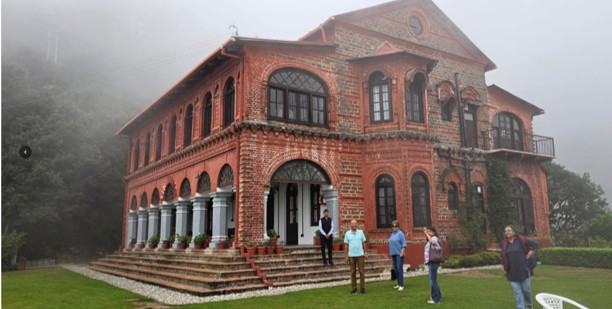
For those who have seen and enjoyed the Netfilx webseries Musafrir Café we had lunch at the beautiful old world mansion that was gifted to Vikrant Massey’s character by the old couple.
The original property is more than 100 years old – and available for stay. We visited it on a beautiful misty day and thoroughly enjoyed visiting its old-world charm as well as the buffet that was served to our group.
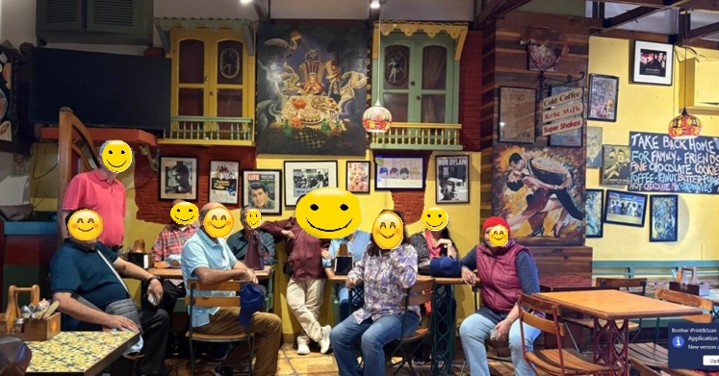
Mussourie proper – as any other hill station comprised of a central Mall Road (not very wide and inclined at various places)- flagged by shops and eateries of all kinds for the tourist. One notable mention is for this cute kitschy café called Chick Chocolate Café serving delicious chocolates (), a variety of hot and cold beverages (largely nonalcoholic) and snacky food – pizzas, pastas, sandwiches, grills, eggs, soups etc. The owner, an elderly gentleman friendly and garrulous manages it and comes in regularly. The service was kind of slow giving the visitor to appreciate the wall art and posters. A must visit for a meal or to just soak in the environment if visiting Mussourie.
Onwards to Rishikesh for the Parmarth Ashram Ganga Aarti in the evening.
Again my memories of the Ganga Aarti are so much richer than what probably is now. When we had visited 16 years ago there were about 8 pandits on a platform between us (sitting on ascending steps) and Ganga ji- such that all had a direct view of the aarti being performed with lit multi-tier brass diyas and
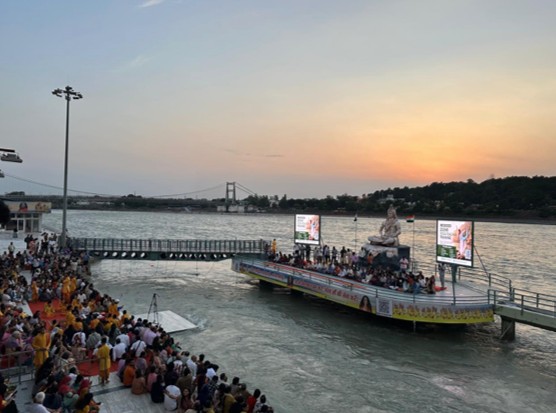
prayers. The movement of the diyas in the hands of the pujaris in itself had a mesmerizing effect which was enhanced by the accompanying melodious prayers.
Today the steps for visitors are right till the river ‘s edge (such that a slight push could topple over the front benchers) with a small platform and a much larger platform across – see picture. The aarti would probably be performed on the smaller platform with the screens projecting it to the seated masses.
We did not wait for the aarti to be performed.
Not seen in the image–but on the far left on the opposite side on the river there was a pyre burning- showcasing the wheel of life along the shores of the river?
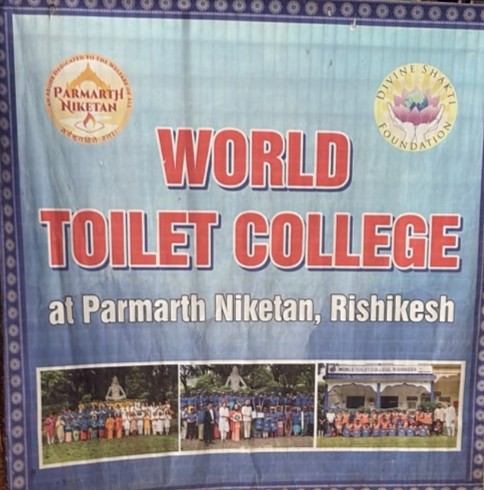
Was bemused by this poster—Googled it – this was an actual event.
“There can be no meditation, no spiritual, religious practice without sanitation”
The World Toilet College is a project of Reckitt Benckiser, World Toilet Organization and the Global Interfaith WASH Alliance. More than 25 specially selected participants from various fields of social work, environmental conservation and science participated in the five day training. Trainers and instructors from the World Toilet Organization from Singapore, Ramli Mehmood and Sarika Saluja conducted the workshop.
Lastly a trip to Dehradun will be incomplete if I make no mention of Gulsarai on the old Rajpur Road.
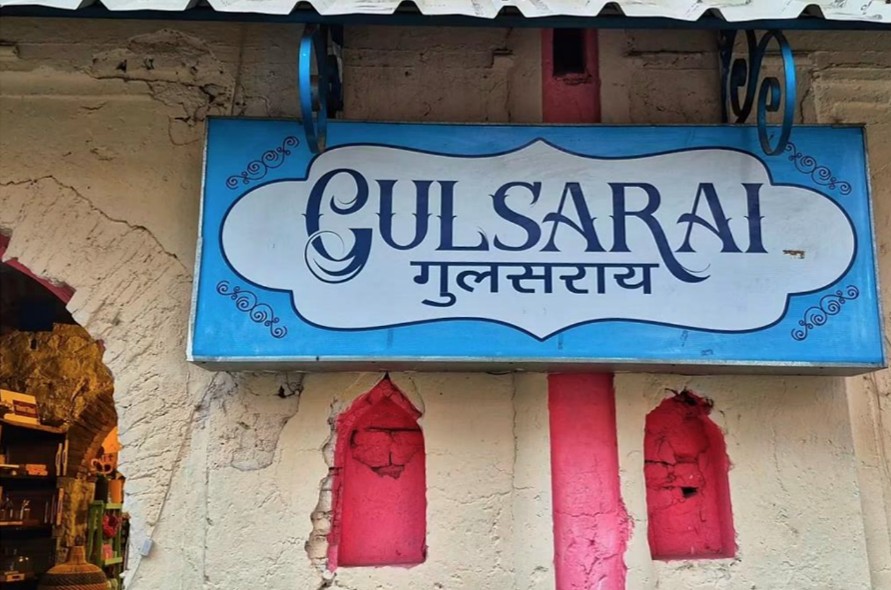
The brainchild of Kumud Taimini- a Kashmiri Pandit (settled in Dehradun) who purchased a 100+ years old broken-down building renovated it without disturbing its character and converted it into this cute cafeteria where she serves authentic Kashmiri cuisine and also provides a place for the local artisans to showcase their products.
While having a hot cup of Kehwa (Kashmiri tea) one can either site on the terrace or the balcony and enjoy the sunsets or city views or one can browse through and shop authentic Uttarakhandi rajmas, rice, dals and exotic spices like Bhange ka Namak, Timur salt , Ama Haldi and many more.
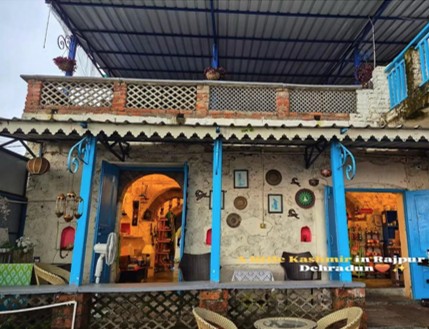
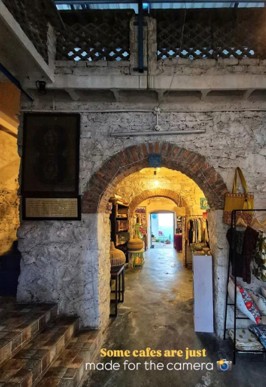
Also hand knitted cardigans , ponchos, room fresheners, lamps and shades in interesting shapes and materials, ( can be made to order as well ) crocheted titbits, soaps and lotions, magnets, serving platters and hoards of other stuff.
Besides Gulsarai- the famous bakery lived upto its reputation (entering it – took me back to Wengers-the confectionary shop in CP- the same aroma. Unfortunately the aroma faded after the first whiff of the shop- but the products sold were worth purchasing.
Besides the Kashmiri cuisine at Gulsarai, there is a Nepalese Thali available – someplace, an Uttarakhandi thali available at Jal Jalebi restaurant at Rishikesh – am sure there would be other eateries worth mentioning….
Who knew Dehradun had so many places of interest – suddenly the city seems like a tourist detination!
All pictures are thanks to the friends with whom I travelled. A few from the net/ instagtram.
NOTE: Most pictures in the article have been clicked by the smileys in the pictures, a few have been culled from the internet/ instagram