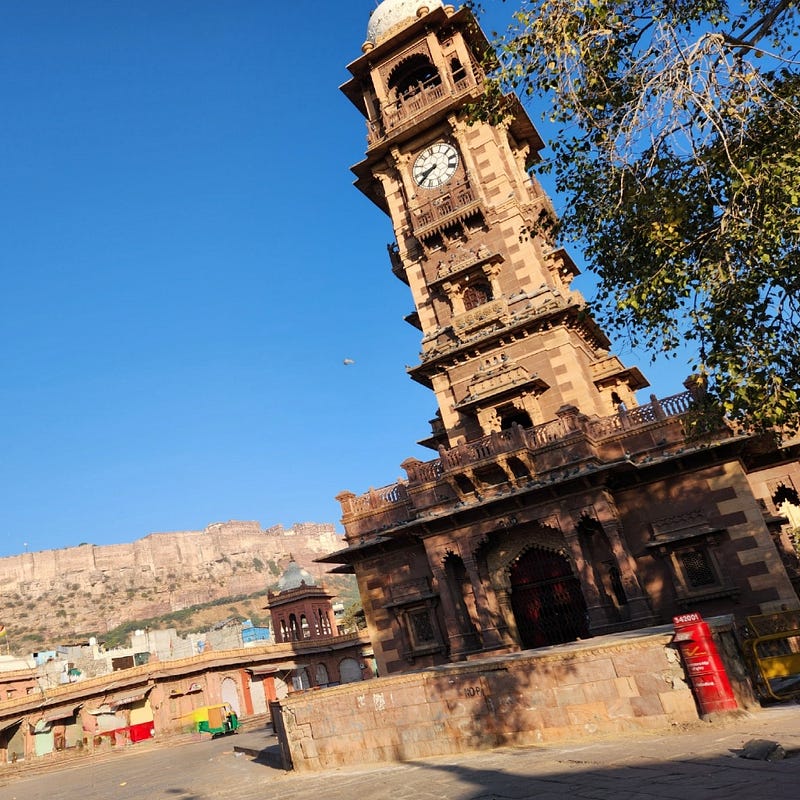
Jodhpur
First Impression of the city from the airport was that its like any B grade city of India- dirty, dusty and dilapidated.
Then I noticed that many of the shop boards (it was early morning so shops were closed) I saw pertained to Library, School bags and boxes and other academic paraphernalia (googling later- showed that Jodhpur boasts many academic institutions)
Next thing to catch the eye were the women in their colourful ghagharas or odhinis — some with their faces fully covered by their dupattas diligently sweeping the roads in the early morning
Arriving on an early morning flight — we headed to town in search of breakfast. The main market is built around the Clock Tower (built around 200 yrs ago) and today, as probably it did in the past remains the central figure of a bustling market square- all being overseen by the looming ramparts of the Mehrangarh Fort in the background Few must EATS here are the Makhaniya Lassi from Mishri Lal shop. A sweet lassi — thick enough for a spoon to stand in- you can drink it or eat it with a spoon — topped with a dollop of butter. Mirchi Pakora (stuffed huge green chilly pakoras- delicious and not spicy) And having the hot kachoris from Shahi Samosa ( tho’ taxi drivers vouch for the quality of food from Janta shop as well)
Entering the lanes of the old city — enroute to Toorji ki Jhallar step well, was enchanting. Narrow streets with havelis on either side (transformed to shops on the ground level and residence on top) It would have been fun to meander through the streets (if shops were open) selling bangles, colourful fabric, silver jewellery, leather stuff, jootis etc. The step well however was disappointing — not deep and dirty. (tho two couple were having a photo shoot done)
Entering the lanes of the old city — enroute to Toorji ki Jhallar step well, was enchanting. Narrow streets with havelis on either side ( transformed to shops on the ground level and residence on top) It would have been fun to meander through the streets ( if shops were open) selling bangles, colourful fabric, silver jewellery, leather stuff, jootis etc The step well however was disappointing — not deep and dirty. ( tho two couple were having a photo shoot done )

A better stepwell- the deepest and largest in India supposedly is the Chand Baoli — we were not able to see as it is in the midst of the city and the chances of getting caught in the wholesale market traffics is horrific. Best time to see this is apparently the early morning / late evening when the markets have not opened for business.
The city was infested with cows- As per locals these are often those cows which no longer give milk and thus have been abandoned- but I am sure the cows are simply left free by their owners to roam the city-An interesting practice that was seen at various places in the city was big mounds of bright green “chara” (fodder plant) being sold on the roads. People on their way to work would stop and purchase a few bundles and either feed the wandering cows themselves or they would put their purchase onto a waiting cart which when loaded would go the cow dharmshala (a safe place for injured, old cows) and feed the cows there

Other things to see in the city as per internet sites are the Rao Jodha volcanic park, the Mehrangarh fort and the Jaswant Thada- the last one we gave a miss- as it was simply a memorial within a beautiful garden ( and those are plentiful in our country) Incidentally the same can be seen from the terrace of the Mehrangarh fort.
The volcanic park is for those who enjoy walking in the wilderness and hiking on rocks- its gully and raw land with desert flora and fauna interspersed by huge tracts of volcanic rocks has its own beauty. tho’ paths have been made its easy to wander off into areas more rough. We wandered off the main track and reached the boundary walls of the fort — climbed up the steps to the rampart where the cannons would have been shot from in ancient times. This was the best part- as we had a beautiful view of the opposite Singhola hilltop (supposedly from where enemy armies attacked) the winding fort boundary walls (much like the great wall of China) and the deep gully and wasteland in between.
Incidentally there is a Zipline which runs over the park- so that may be another fun way to experience the park
The Mehrangarh fort , however is a fort that should be seen but ideally with a guide — to fully enjoy it. The spice they add — even if its folklore or make belief (in all probability) is what makes the tour worthwhile.
Built over 573 years by various hierarchical kings its an amazing feat that the architecture, the intense carvings on the walls the structure have been kept consistent such that it seems that the entire fort sems to have been built in one go

Perched high on a hilltop- it has a broad walkway as well as multiple steps to the top. It also has a lift which runs up the 12 storey of the fort (a Rs 50/- bucks pass for the lift is highly recommended)
Interesting Fact- unlike most forts where room attendants are men all attendants here were middle aged ladies- also the tourist shop proudly displays that all proceeds go to girl child education- seems like women empowerment is a focus of the city.
(enlarge the picture to see the carvings)
One of the interesting anecdote is regarding the huge cannons on the terrace of the fort which face the afore mentioned Singhola hill. Apparently as the menfolk of the palace were all involved in fighting the enemy (and losing) the queens and their ladies took it upon themselves to drag these huge cannons upto the fort terrace- on bullock carts and subsequently were instrumental in winning the war. besides the cannons there is a hugewheel of the supposed bullock cart (???- survived the years bygone?)
Besides the exquisite carving all over the fort and the stupendous views all round — the rooms have the usual assortment of kingly paraphernalia- attire, swords, guns, a whole range of howdahs — made of wood but with gold, silver finish, mirror work finish- a different howdah for the king (gold) queens (silver) accountants ( mirrors) peacocks (Princesses) etc

Amongst the many palace rooms was one where the chausar (origin of Ludo) was laid out — and the spice as narrated by the guide was as follows — each evening 4 of the 30 queens of the king used to play a game and the winner got to spend the night with the king. However, amongst the three losers the one most favoured by the king got to spend 1 third of the night with him too — where the king descended via a secret staircase between two rooms to visit her and then to return to the winner queen’s room before morning.
the Blue City — much touted on the internet is much better seen on the internet- in real life it was……. maybe if we walked through the city we may have been more impressed
All in all an interesting city — worth a visit if in the vicinity.
Jaisalmer
Was disappointing in a word- or maybe our expectations were too many.- or maybe the half day we were there was too small a window to explore and experience the best of the sity
The city also called the golden city (due to the golden hued stones found here- consequently used to build) has so much potential but the somehow authorities have seemed to not take any interest.
The fort is beautifully built- with 4 winding huge doorways into the castle which in itself has various alleys and pathways- areas belonging to the kings and queens, a cental space for common activities, multiple Jain temples ( apparently Jains were a flourishing and wealthy community and they purchased many tracts of the palace land and build their temples) one of them is a very famous Parasnath Ji temple- which has a huge following with heavy pilgrimage traffic. constructed of a stone which shines and hardens with constant contact but looks wood like wehre there is no human touch ( roof and upper pillars) and the entire temple is full of intricate carvings- right upto and on the temple roofs.
Apparently the entire city population lived within the palace walls, when the palace was built in1156 AD. Unfortunately, the descendants of those original inhabitants still live in the palace. the king-( tho’ a king in name only) has moved out and lives elsewhere.) The result is that the fort is congested and its narrow streets have shops on either side selling all kinds of stuff to attract tourists. the pressure of humans living inside has been too much for the fort to sustain over the ages and its showing cracks and breeches over multiple spots- all haphazardly repaired in an ugly manner.
the city with its narrow winding streets and beautifully carved houses with Jharokas (windows with carvings) would have been really beautiful if the streets were clean.
Many old huge havelis with beautifully carved facades are worth seeing.
Im sure the desert experience would be awesome as would be the various sports activities on offer — — not done so not writing
Just a last note- one of the most recommended places to eat was the 1156AD named after the year in which the palace was built) and belonging to the current royals (who incidentally have the restaurant within their extended residential compound) — SPICY food — to another level. Delicious but we have a saying in Hindi “ dhuen nikaal diye” was true here. do not forget to order a curd dish to cool the tongue and palate.