Instead of the l..o..n..g 8 hrs journey this time we opted for travelling on the Vande Bharat till Chandigarh and then took on the hills by road.
VB with its cream exterior, clean interiors, swiveling chairs (a surprise), serving staff in their Himachali topis was a pleasant journey
The roads by enlarge were in good condition- being made better by making it a 4 lane one till Simla (maintained as they are by the Border Force- it would be soon)
As we neared Solan, bushes of yellow lantanas (on either side of the road) and pine covered hills started to accompany us, sadly to disappear till Kandaghat…a bustling township with a famous besan ki barfi made in desi ghee (not a fan of besan sweets so held no charm)
Post Kandaghat it started to feel like a route to the hills…mountains on either side of the road, pine trees, cactii, scattered Arocaria.. (Christmas tree) here and there. Shogi (with the emergence houses with sloping roofs, hills as far as the horizon interspersed with dep valleys), Taradevi, Victory Tower and we were nearly there.
Roads now are curvaceous with deep sharp turns.
Word of caution: Himachali drivers are like the Delhi auto drivers. They come up from nowhere, left or right (made them no difference), a blast of horn and they’ve whizzed past squeezing in the small space they saw!
Two passably decent food and loo stops.
Chawani at Solan… A cafe featuring army paraphernalia seating made with nets and hammocks, bunkers, tyre and oil drum tables and chairs, tents, army music, food served in miniature army trucks, bomb boxes — the owner’s dream to belong somehow to the Indian Army. He had apparently failed multiple attempts to join.
Grub Hub. A few kms ahead…literally a hub with known food brands outlets. Decent loos, ample parking, service not as fast as we would want- a reasonable pit stop midway.
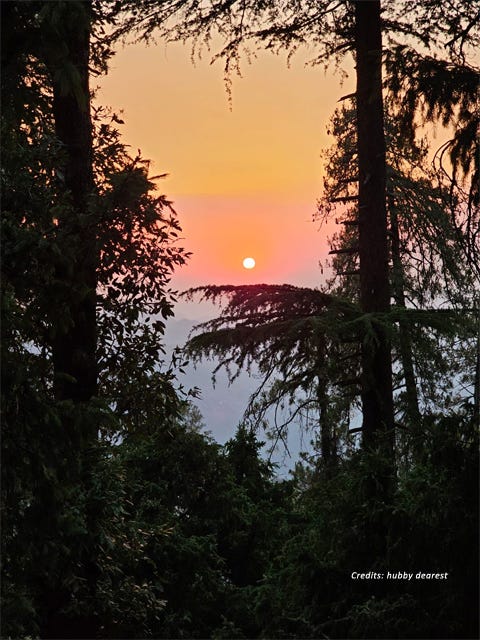
Sanjauli Dhalli …and we are in Deodar territory. Pines, Blue Pines, majestic Deodars, cool winds, great views. The unusual dry spell of this year has not diminished their presence- tho’ the heat has made its presence felt in the burnt and dry edges of the needles. If by chance you are on the road at dawn or at dusk, you will be rewarded with stunning sunrises and sunsets. Just stop the car and shoot to your hearts content- share pictures to the envy of friends.
Side Fact: The Simla police force is well turned out- Slim and fit with their dark glasses and their white or khaki uniform. Men and women – both deployed all along the Simla district roads (heavy traffic). Amongst all the 60+ police force I saw, – just one man with a slight pot belly
The raja of Koti (to whom district Simla earlier belonged) and then later when the British annexed it and declared Simla to be their summer capitol as well as a place to revive health and spirits – a sanitorium.
Till today it is so – given the large no. of Ayurvedic, Yunani, Homeopathic teaching colleges and hospitals we saw enroute. Also a few large allopathic hospitals, Trauma centres.
Way back, the British with their love of documentation and recording had found Simla to be the home of more than a thousand species of plants with 40% of those found only in the Himalayan belt. Till date most locals prefer the natural manner of healing based on plants and nature resorting to allopathy in dire needs only.
Besides relaxing, walking in the cool hills, feasting on vistas during the day and star gazing at night we did see a few places

The Retreat or Rashtrapti Niwas (as the Indian President’s official summer residence is called) is touted as one of the MUST do things while here. — By law each president HAS to spend at least a week each year here.
Built in the 1850 by the raja of Koti as his residence it was added to in 1895 when the British took it over.
The Drive up is great- steep inclines and we are soon on top of the world- literally — all surrounding mountains and peaks are lower and we are driving in the midst of thick, tall deodars (it is said these trees can live thousands of years and are considered sacred — so never cut and used for firewood, furniture. Even the trees that fall down due to natural reasons are left where they fall- unless I guess when they fall on the road — then they are just shoved off into the surrounding forests.
Two Copper Beech trees in front of the residence were planted by Lord Kitchner a century ago. The leaves apparently change their colours with the seasons.

The internet says there are two large brass elephants at the entrance (we did not see any). The entire property, its furniture, etc is made from wood (teak, walnut, pine) .
The upper floor is reserved for the Presidents stay and not open to public while the ground floor consists of a a cordoned off meeting room for delegates which still retains the wooden fireplace, British era furniture, two rooms facing each other for the ADC’s and a huge dining room which can seat 22 people. A gallery of previous and present presidents.
The guided tour is disappointing– the guide rushes you through, not sharing any historical anecdotes nor interesting current titbits. Go if you must –but do not be sorry you missed it.
The Water Catchment sanctuary is another place to visit- a 7-mile-long trek through the densest forest of Deodars (apparently the densest in Asia) — all you see is these amazing trees- in front, at the sides, all around. The road is quite bad- rutted and unpaved mostly. The road leads you to the reservoir which can store upto 100 million gallons of water- again bult by in the 1800s. you can walk it, bike it or go via the EV. Carry water specially if you are on foot or on two wheels. The route is dusty (when we went) I imagine during the rains and in winters the experience would be quite different. Early morning and dusk time you would see/ hear birds.
Jhakkoo Temple at Shimla- a 108 feet tall statue of Hanuman — which overlooks the entire Simla township. Built atop a mountain peak it can be accessed by road ( tho’ it is quite narrow at points), by foot (for the agile and adventurous) and by cable car.
It is prudent to purchase a ticket from the vendors on the Mall road — make them put in your no. In the line (wait times can be 30–60 minutes easy unless you are amongst the first to arrive). The short cable car ride is scenic giving you a view of the crowded city down below and the majestic trees above. Tho’ we were warned that monkeys at the temple site are rowdy and prone to snatching caps, bags, chunnis etc we found them to be quite tame and uninterested in anyone except their own ruminations.
Neat and clean environs- with a mixture of the curious, the devout and the tourist. Multiple food stalls, gardens and balconies to relax in and enjoy the cool breeze. Way back down the cable cars is another 20–30 minutes wait.
That’s all we saw this time round — next instalment may have some other places 😊