Turkey is lovely and a place you would enjoy — not just the food (highly non vegetarian) — but the energy and people, the music and the sights- amazing — but let me write it all in detail.
Flew straight to Antalya — (after landing at Instanbul ).
Antalaya is a city divided into two parts –one is the beach part — a typical beach city anyplace — overflowing with sea side hotels and the sea . The sea is amazing — a deep rich aquamarine blue (not seen in Bombay/ goa- unless you go out into the sea) — the waters are very clean and warm. Did not go inside but if would have been wonderful I imagine.
The beach stretch is owned by the govt which has leased it out to some major orgztn for a long time — was it a 100 years or so — I forget- anyway the organization has divided the beach into 14 segments — each subleased further to smaller layers — so imaging this long stretch with beach 1, beach 2, etc till 14- each part vying with each other to attract people- so they have swings and cosy nooks in gardens on the front side facing the road) and shacks and loungers and covered cushioned canopies, sand sculptures, music and bands blaring at the sea facing front.
We spent an evening there- ordering 4 drinks & some eats from them and then having the smuggled in (our own whiskies and pimms, etc) — had a great time — tho’ wish they had lights for the evening- post sunset (don’t think people loiter there at night- as we were one of the very last to leave)
Taxis are very organized here — outside each beach entry there is a push button for the taxis — which automatically has a taxis coming in to pick you up. Tho’ many taxis easily took in 7 — some of them had junk stored in the boot (where there were 2–4 seats- as in a jeep) and as we were seven — sometimes a few of us had to sit in the boot, with the junk.
The city part is about 30 minutes away by road- is a quaint town with winding interconnected roads and alleys- streets of cobbled stones and small residences — some of them as old as 400 yrs old — converted to hotels and pensions or in small shops selling stuff of the category sold in Janpath and restaurants- some local some sophisticated. As this was a Govt protected area no unscheduled, random construction could take place. — as a result the rooms are really small (a smallish bed for two — with a cramped seating area and a small dresser. No place to move about. No fans ( and it was so so hot and humid) — ACs were there but did not cools quickly nor efficiently — as a result we left them running even when we were not in the room. This area we stayed in reminded me of Chandni Chowk — tho- a westernized and more modern, cleaner, less crowded one.
Cappadoccia
After waiting in the heat in the bus (airport to city is a distance- resort helped book a bus) for about half an hr or so — for 2 “lost” customers who were supposed to be going in the same bus as us to be transferred from Keysari — where the plane landed — to Caapadoccia- our destination- we were finally off.
It was night so I dozed on and off ( guessing so did the others) — smooth straight well tarmacked roads- but suddenly woke up as the bus swerved- woke up to a magic land- could be straight out of Hobbit land of the Lord of the Rings.
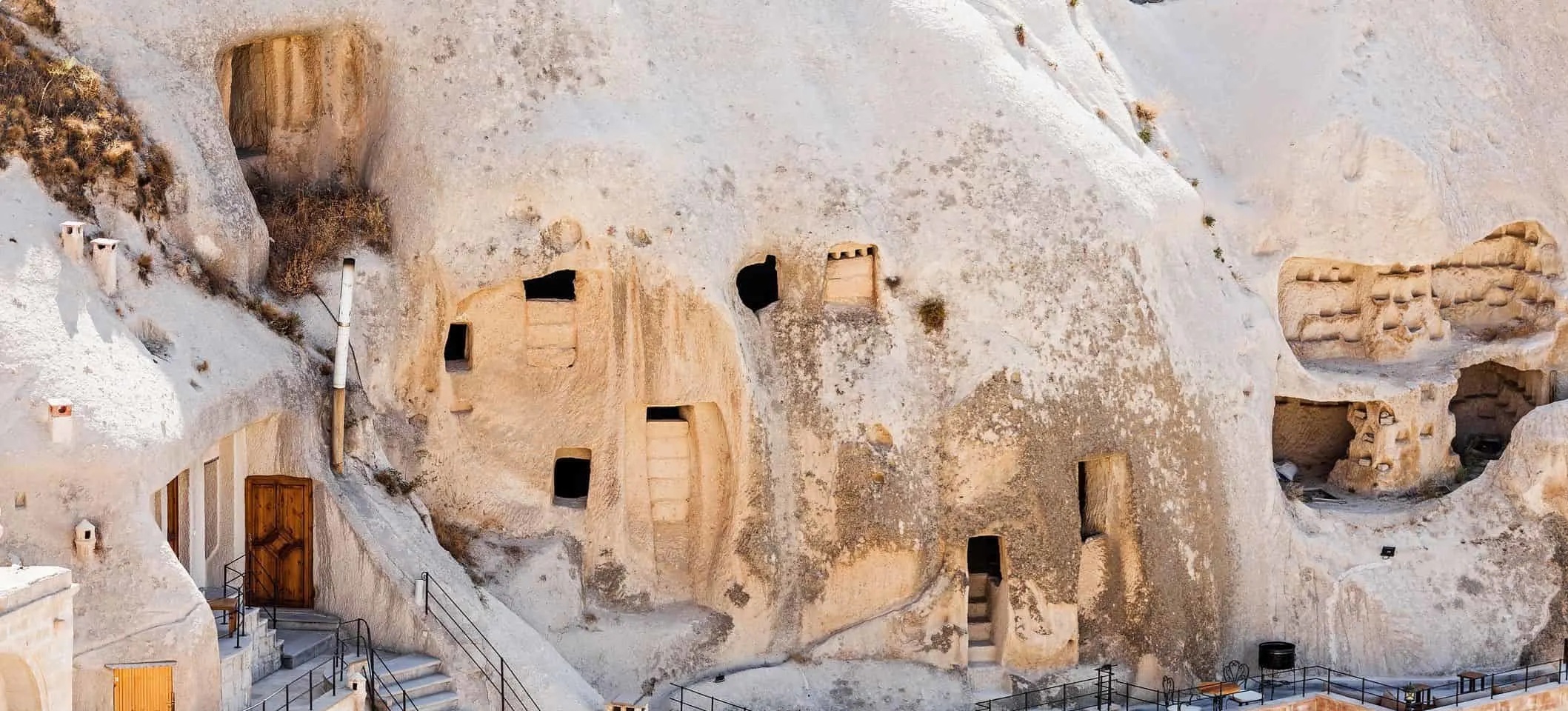
Twisting turning narrow roads going uphill and downhill ( throwing the backbenchers in all kinds of directions) interspersed with these small hill like structures with crooked slender chimneys, or pointy peaks- mountains with small cravens and holes- some with windows fitted in and lit from inside. This was Cappadoccia — the land of caves- where in ancient times people stayed either in the underground cities ( 7–10 storeys down) and as wide as our block in Haus Khas. Or in interconnected caves in the mountains ( made of soft sand stone kind of rocks which kind of flakes off in particles on touching) scattered all over the countryside. Imagine one storey houses with flat roofs one atop the other ( as in paharganj) with a peak with holes jutting out amidst them.
Hotels , shops, residences- have followed the cave architecture with most hotels having sunken rooms –either within the cave itself, or made like a cave. The rooms which were part of existing caves are cool and damp with the walls being cool/ damp to touch.
The underground city- actually an entire city built under the ground interconnected via tunnels . It had designated areas for living, storage, cooking and even had clever areas where boiling water could be thrown down on unwanted intruders.
tho’ amazing it is not built for tall people — there was not even one room (maybe excepting the kitchen cave) which was high enough for a 6 footer to be able to stand up straight comfortably) and the narrow passages connecting the caves — even we had to bend down double to traverse the 10–30 feet long passages.
There were so many tourists in the various parts of this underground city simultaneously yet there was no feeling of suffocation or stuffiness- makes one wonder at the air passages created for ventilation throughout.
The other high point of Cappadocia was the hot air balloon ride. Apparently Cappadocia is one of the few places world over where hot air ballooning is a regular feature- compatible wind and weather conditions. Blogs had cautioned us to carry hats and warm clothes –as it gets very cold high up — -but it was all hogwash. All the 32 of our party (16 in each balloon basket) were wearing sweaters and jackets — some ladies wore a wind cheater over their sweaters — -but beyond the early morning half hr (they picked us at 4.45 am from our hotels) they were an over kill.
Climbing into the balloon was an effort- more so for us Indians who are not very limber in our limbs and have tough times raising our legs to levels above knee height — but once we were in the ascent of the balloon was so smooth and so swift that we were airborne and looking down even before we realized it. It required such precision skills from pilots — took us right till the edges of the hilltops/ tree tops/ ravines edges, etc and then while landing ( of course with some navigation help from the ground staff) they landed right on the trailer attached to the jeep which would carry the contraption back home these pilots had. A lovely experience.
The world below looked very much the same as it did from the helicopter ride at vegas we took .
Food; amazing figs-plump and juicy — they were so good that I think the slight constipation we all were suffering from (too much meat without enough roughage- in the preceding 2–3 days at Antalaya) soon was a thing of the past. ( too complicated and distracted a sentence- hope it made sense- too lazy to go back and reformat) — various kids of olives- juicier and fresher than what we get in Delhi- lots of brinjal and spinach is used in the food — spinach in dahi, spinach in salad, spinach in rolls, brinjal dips, brinjal barbecued with meat, doner kebabs, curd kababs ( beef rolls covered with curd) , beef, lamb and chicken seekhs, and tikkas, potato in jackets kind of a thing which tasted like the kind of potato tikkis we make at home with peas and carrots in them. A namkeen lassi kind of drink — called Aryan- as popular a drink as their Turkish tea (slightly bitter black tea- had straight or with sugar in these 8- shaped curvy transparent glasses) and the Turkish coffee (awful- bitter and with sediments) — some say — even the Starbucks cold coffee in Turkey had a bitter aftertaste- absent otherwise in Starbucks in other countries. Same fruits that we have in Delhi- bananas ( smaller in size same taste) watermelon, melons, kiwis (hard) , peaches (Huge 4 times the size we have here and so very sweet) apples, grapes (huge) pears (looked like guava and were slightly hard but sweet) , all kinds of cheeses- some odd yet delicious — chocolate missed with cheese (imagine blue cheese but with chocolate instead of the blue thing) baklava’s- and Turkish delight — already have come to Delhi — a rice pudding which was kheer made in custard (instead of milk) a very very sweet thing made with fried vermicelli sandwich with cheese filling — all of them very very very sweet and drippy.
Turkish cuisine typically uses the same ingredients but prepared differently and tasting different than Indian food- but limited in variety — ate at various places- local street side as well as fancy dining, in different cities –but all typically served same/ similar variety of food and dishes — unlike India –where cuisine changes from city to city. Or maybe we did not know enough to taste (as they do have angolian, Turkish, ottoman cuisine)