जुल्लेय That’s Hi in Ladakhi.
Finally a long awaited trip … 🙂
The magic started right from the plane (leave aside the fact that to board a 5.10 Am flight we got up at 3.00 at night). Half way in the 1 hr flight time — the plane was surrounded by clouds — sitting in the aisle seat- had a clear view out of windows n either side- Clouds so thick and formatted with ridges and grooves that a picture of them would seem to be a tundra terrain of a cold desert– rather than clouds ( wish I cld have taken a picture) An amazing sight was seeing small perfect circular rainbows forming on the clouds every time the sunlight hit at an angle- unfortunately again no pictures to show. The plane, while descending went thru thick clouds for nearly 4 minutes (I timed it) — so big deal — you may say — -but wait — there were NO Bumps, no air pockets, no shudderrings and rattlings at all- just a smooth ride through the white-much like they show in fairy cartoons.
Leh — a city- scattered between these huge multi-hued barren and stark mountains-
Scattered???
The dwellings were either thickly populated in some areas or wide spread and single with patches of circular patches surrounding them ( barley and wheat crops) Where ever there were houses there were trees- typically popular and willows — — the popular grew tall , thin and straight with leaves trying to reach the sun (in the planes the tree has a larger width) the willows usually droop downwards and look like a bush rather than a tree — here the willow was upright- with a trunk and leaves reaching upwards — seeking the sun.
Downtown Leh is all of a 1 km radius circular crisscross of 5–7 streets — with shops selling artifacts, silver — turquoise and coral jewellery, pashmina shawls, woolen caps with long pigtails, brass artifacts, tankhas, prayer rolls and eatings joints and hotels. Hotels were typically single o a storey or sometimes two storeys over the shops, white walls, wooden latticed windows with wooden carved parapets, cornices and borders. Much like the swiss chalets- just substitute the dark brown wood with molten gold honeyed wood and the flower baskets at windows by carved wooden blocks. Houses too were white, usually single storeyed with 2–3 large windows on the front façade the roofs were flat and stacked with bundles or rather clumps of dry grass or wooden sticks tied together and stacked one on top of the other. Must be serving as insulation as well as easy access in winter months. In fact this was a construction element used in the old ladaki palaces as well there was the wall and on top of it was a rectangular panel running the length of the wall and a foot and a half in height- in which small bits of long wooden peices were stacked together — imagine a tooth pick box seen from the side — all pointy toothpicks pointing at you.
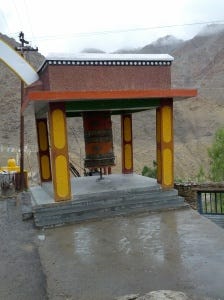
There are huge prayer bells installed all over the city and people stop by to
rotate the wheels as they went along their way. Another much seen were the memorial stupas- white washed square enclosures topped with a dome built singly or in pairs of three or four in a row — sizes ranging from length of the arm to as high as a man or somewhat taller. Inside these memorial stupas the people put offerings for their ancestors and Gods to protect and look over their well being.
The first thing that hits you in when you land in Leh are the MOUNTAINS. Will write about them when I write about the two Passes Khardung la and Chang la .

Once you get acclimatized to the lower density of oxygen and start to move around the city and its environs you see the second most often seen sight — the MONASTERIES.
80% of the population is Buddhist- the remaining 20% being muslim (we saw no churches, hindu temples and the single gurdwara maintained by the Army — story about it later) Monasteries are always on top of the mountains — where typically the mountain peak would be. the monastery is made such that it follows the line of the mountain with it on the peak followed by residences of lamas going downwards following the line of the mountain

Likir, Thiksey and Diksit were three monasteries we saw — two had these gigantic statues of Lord Buddha — the one at Diksit has such a serene expression on its face that the image is still visible if I shut my eyes and focus and of course the views are extraordinary — given the height of the monastery. Thiksey seemed to be really old going by the smoothness of the stone floors and thick wooden pillars
Leh lays claim to having two of the highest motorable roads within it. the Khardung La (La=pass) at 18380 ft and the Chang La at 17500 ft Despite the heights the roads are in great shape — barring the last kms near the top — which our driver told us could not be in better shape due to frequent snowfall and frequent removal of the snow — were well maintained. the gradient of the road towards Khardung La is sharp and steep, the mountains stark and barren yet with patches and streaks of multihued blue, grey, purple, magenta and green their starkness broken by the many silver streams zigzagging down the sharp slopes

– Those who have altitude or mountain dizziness — be prepared for some uneasiness and nausea.
On note worthy comment I must make is that despite the many streams running along the mountain and roadside — not one of them had water running over the road tarmac — Labourers on the NREGA (an Indian Govt initiative where those below the poverty line are ensured a 100 days paid work annually) project ensure that bridges are made way which have the streams running under the road.
The roads to Chang La on the other are gradual with long stretches on nearly long roads- the hills are wider with deep valleys — more often than not which have small villages with green and yellow barley and wheat patches surrounding them. Rather than small multiple streams there is the Indus and its tributaries running below in the valley. the mountains too are more brown and its shades and green with small shrubs growing here and there. In fact there were bright yellow flowers on each side to the road for the longest time.
Leh Ladakh- a beautiful place no doubt but only for those who love nature in all its forms- including the harsh, barren and tough. for those of us for whom natural beauty is just a part of the main picture, Leh can just be long long never ending roads and rock mountains.
Yet even those who can enjoy it and get lost in its beauty should at all times be prepared — one tire burst or a skid on the road, one spell of bad weather (strong skin sizzling sun or bitter cold winds or unrelenting snow) can play havoc with ones trip.
The heights at the two passes have to be treated with respect — in our excitement we can tend to forget the dangers (as we found when a friend stood for just 10–15 minutes with an uncovered head in a very mild snowfall- she was unwell for 24 hrs subsequently)
Basic amenities on the road are few — more so when travelling towards Khardungla and Changla- Suggest ladies use the (one- two) paid loos at the basecamps or relieve themselves shielded by barracks/ boulders. The loos at the top are few and are stinking, dirty and in some instances may be overflowing- I guess extreme weather and large tourist traffic is to blame.
City dwellers like us- used to roadside dhabbas for a quick bite and a hot cup of tea will not find the same in leh. We purchased a carton of bottled water and each carried a litre of water with us at all times. Guzzled water like never before and also relieved ourselves of it — many more times than we normally do.
Nubra valley and the Pangong Lake
We reached Nubra after a long journey across mountains — scenic no doubt but long (made more so as one of our group was slightly unwell). Enroute, we came across a lake so still tat the entire mountain range encircling it was duplicated upside down in all its glorious detail. A true picture postcard setting. a WOW experience — one of the many such we had in Leh.

Nubra is a huge and wide sandy valley with deep sand dunes encircled by high mountains all round on which the play of sunlight presents a moving panorama of colours thrown in relief or in shade. It is typically a cold desert formed when the
he Shyok River meets the Nubra or Siachan River to form a large valley that separates the Ladakh and Karakoram Ranges. The average altitude of the valley is about 10,000 ft. i.e. 3048 metres above the sea level.
That is sand you see in the picture below….

It is easy to imagine oneself part of the caravan crossing over inhabitable mountain passes and following the silk cotton route of the past — taking a respite from the journey and resting in this valley — -more so when caravan of the two humped camel (the Bactrian camel- one of the few places it can be seen in) carrying traders (tourists) on their backs can be seen in a distance…. and then when the day is setting — one after the other — the mountain shine gold where the sunrays fall getting lost in shadows when the rays pass on. A musical symphony of sight.
This was where we saw the elusive pashmina goats as well — frolicking in the thorny shrubs.

Pangong lake — — so much has been heard and read about it yet it is an experience out of the world when you seen it. The terrain enroute is rugged — often the rocks seemed precociously balanced and almost seemed to fall onto the road, while at others it was sheer rock face towering high above you.

The tinkling streams and rivers- which often ran along the road brought in a much welcome relief to the starkness of nature. and then you glimpse the lake from in between the ranges- a small visible upside down triangle of aquamarine blue — so bright and welcoming which disappears as the road turns and then the LAKE !!!
A lake which seems to be painted by an imaginative and great artist — it just does not look real- it is so beautiful.
Deep blue sky with fluffy wide clouds casting moving shadows over the mountains and the water giving it various hues of blue , indigo and purple and all the shades in between. A lake so huge that you can see where it starts but cannot see where it ends- almost like the Lake Michigan of Chicago which lies between two states. The Pangong lake exists for for as far as the eye can see and still it is only 25% of the lake that is in India — 75% is in the Chinese territory.
Extremely windy- a place to see the sun rise and /or sunset for the play of colours over water — unfortunately we saw neither.

We had vistied Leh in Aug — the best time for a visit and we had great weather- mildly cloudy with mild drizzles now and again — yet the nights were really really hot — and we woke up often with parched dry throats.
All in all I was humbled my Leh- not because of its majestic mountains — but by the people who have carved out a life for themselves in this inhospitable terrain and who live and enjoy it. We constantly saw laughing school children, wizened old men and women revolving the prayer wheels all over the city, cab drivers who would give way on he roads and pass each other with a cheerful wave or acknowledgement, and everywhere we saw symbols of the people faith — the white painted stupas — in all sizes big and small- interestingly none of them showed any sign of wear and tear- so someone must be looking after them