Visited the Nizammuddin area yesterday evening-(a walk organised by the LBBD) the area is named after Hazrat Nizamuddin Auliya a sufi saint who initiated the Sufi movement in India in the 13th Century or so.
It is said that when Hazrat Auliya was building his mosque in the area — the reigning king Ghiyasuddin Tughlaq was also building his own Qila at Tughlakabad.
Jealous of the following Auliya was gaining amongst his people the monarch declared that all builders/ serfs etc would work only on the building of his own palace.
The love the people had for Niazmuddin auliya was so great that they helped to build the mosque at night.
The king then commanded use of all the oil in the kingdom for his own use so that without light the work would halt. The saint with his powers then lit lamps with water and got his mosque built.
At the same time he cursed the king –that this city you are so proud of –will be lie in dust and ruins and will be the abode of animals .
Fact is that today- despite a whole lot of old ( much older than Tughlakabad even) still stand proud but Ghiyasuddin Tughlaq’s city lies in absolute ruins and barrenness while the mosque built by Auliya has scores of people coming in to pay homage.
That is how, it is said, that the area came into existence and Nizammuddin was born.
The area still has narrow meandering ‘gallis’ and lanes with rooms perched randomly a seeming dead end, which on approaching close would open out to yet more narrow lanes receding into a maze-like cluster of residences.
Anyway — the assembly point was at the start of a gali in the Nizamuddin basti. A dark night (wish it was full moon) with a narrow street hemmed in by small kiosk like shops lit up with cheap light and protruding tavas and degchis– with hot smoke (like steam) wafting upwards from them, a sudden burst of fire sparks flit across as the fire is fanned and embers glow red emitting sparks in the sir. And of course the never ending steam of people — walking or loitering around, a two wheeler would whiz past , occasionally a four wheeler would barge its way through the seemingly obtuse crowd…..Close your eyes however and you would be transported — at least the non-vegetarians would be — to a sensual heaven- the smell of roasting kababs is in the air! So much so that while we were waiting for the group to assemble we could not resist buying a tikka roll and eating.
Another interesting combination being sold was halwa served rolled up in a huge crisp puri made with maida. Sounds -ugh –but tasted great.. Of course if one is picky about eating street food this is obviously not the place for them
The people are majorly Muslim — you see men with beards in all lengths and colours ( interestingly did not see a henna-ed beard amongst all those I saw) — obviously the men on the road were more than the women ( maybe also because it was night time) — some women were burqa clad while others were not — but most women were wearing chamki- glittery outfits- even if just a glimpse of glitter was seen through the black abaya. Did not see any young girls by themselves.
Two things sold here –which are not generally seen sold in other markets were Itaar — a scent made by flowers and floral extracts and leather zipped up socks — -apparently these ankle length leather socks can be worn inside the mosque keeping the devotees safe from the cold marble floors. I checked what the biggest foot size available was — -size 12. Would be good to wear inside the house in winters- will keep feet snug.
Visited one of the bigger shops selling itaar — imagine a dimly lit apothecary with interestingly shaped glass bottles in various shapes- conical, cylindrical, squares, ovals , huge vats and small drums- filled with colourful liquid — fresh grass greens, woody browns, oranges and yellows — some with glass stoppers others with sandal wood conical stoppers- some smaller bottles for retail had cotton roll-on nozzles with a cover. Presided over by a rotund Muslim gentleman with a short unkempt mousy brown beard sitting in a corner weighing out proportions using a tiny ( about 9 inches tall) taraazu. What was missing was a faint aroma of pervading perfume and a customer clad in a bright turban with painted nails and oiled eyebrows getting a personalised itaar created for himself.
Ok — Ok — a lot of that was imaginary and romanticized but that is how the shop should have been –instead it had given way to modern times and was a sanitised version with cheap reksin stools and sofa, lit with tubelights — -but the interesting bottles were for real.
Had a quick dinner at one of the better-looking restaurants of the area- chicken seekhs & paneer tikka (routine), tandoori chicken (extremely succulent), malai chicken — kababs smothered in creamy buttery gravy ( yummm- never seen malai tikkas served like this) — with romali rotis (kept hot in an icebox!) Interestingly the menu did not serve any mutton instead they had Beef. I tasted a beef seekh and it was much like Khub Chand’s mutton seekh only much more juicier.
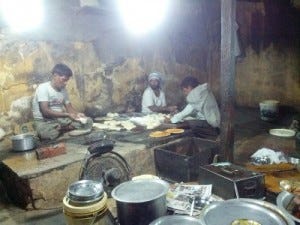
Saw an open air eatery with an open tandoor — pic says it all. Customers were seated at the right –beyond the tandoor.
There was a beggar — dressed in orange and blue wearing a turban and a huge bushy beard — also holding a stout bamboo stick — standing right next to the shop and who asked me to feed him — giving all kind of blessings- and when I ignored he turned abusive and kept hurling it at me while following me down the street ( I was too scared to take a picture of him — he would have snatched my phone and thrown it — he was that aggressive- yet he was picturesque)
The Dargah– the mosque built by Hazrat Nizammudin — where he was finally buried as well- is reached through meandering walkways — encompassed by shops selling puja samaan ( like shops near our temples- only the puja samagri is different) –

Desi gulab- opened out flat interspersed with the smaller two coloured marigold flowers, itaar, incense sticks, sweet kheel- patasa, thread ( for tying at the jaali and making a wish) and colourful chaddar with quotes from the Quoran printed on them)- pic below picked from the net- or by small graves ( of the faithful who served the mosque or the saint) or by beggars ( the bane of all religious places, I guess)
Finally the courtyard with the mausoleum of the saint in the centre- painted floral motifs over a golden background, chandeliers, latticed windows for the women to peep into ( only men are allowed in the holy sanctum or the “muradi” to tie their threads and make a wish. Behind this was the mosque .

Also in the same premises are the graves of Jahanara (the eldest daughter of Shahjahan who was follower of the saint) and of his star pupil Amir Khusru .

Despite the practice of devotees washing hands and feet prior to entering the shrine — there was no wet floors nor kichad anywhere, the floors were relatively clean, the throng of devotees was continuous with their puja thalis– as was the clearance of flowers in huge plastic canisters by young boys — no beggars were in the inner courtyard though all around people could be seen sleeping wrapped up in their blankets . a few families with children had laid camp in the corridor of the dargah.
And the famous Quawwali by the Shabri Brothers Centre stage- right opposite the doorway to the saints Mausoleum- engulfed by the crowd of listeners- all classes, nationalities and social classes- sitting mesmerized. Was it the music (sonorous rapturous singing accompanied by loud rhythmic clapping) the environ (music was the only sound- despite so many people, the perfumed air due to the innumerable incense sticks devotees burned at all corners of the courtyard corners, the ancient tombs), the whirling dervish kind of trance- dance — some devotee jumped into or simply a predisposition to enjoy the evening — I was totally enamored by the experience.